
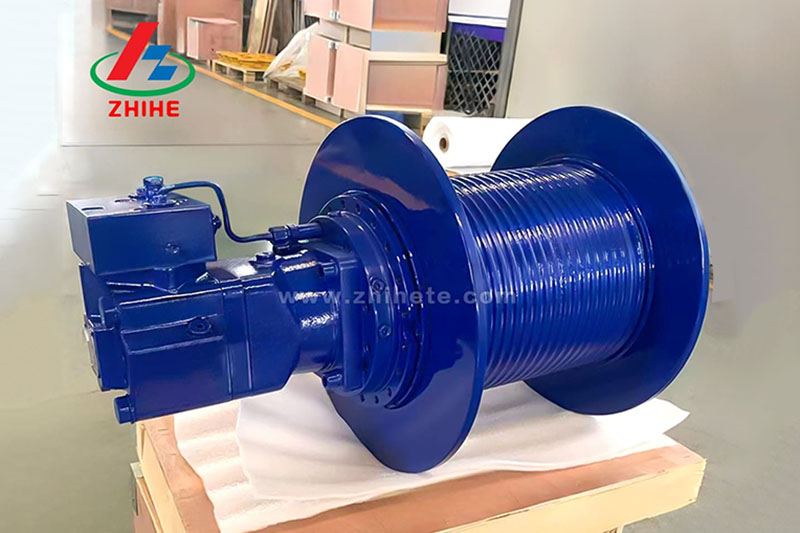
Introduction: Why the Winch is the “Heart” of Your Crane
The truck-mounted crane (also known as a knuckle boom crane) is an indispensable tool in modern logistics, construction, and power maintenance. At the core of its operation lies the hoisting mechanism—commonly referred to as the hydraulic winch.
Think of the winch as the “heart” of the crane. It is directly responsible for lifting, holding, and lowering heavy loads. An improperly selected winch can lead to inefficiency, frequent downtime, or even catastrophic safety incidents.
While the market offers various hoisting mechanisms, the planetary reduction winch has emerged as the industry standard for high-quality cranes due to its superior performance.
In this comprehensive guide, drawing on the engineering expertise of ZHIHE Intelligent Equipment, we will help you understand why planetary systems are superior and provide an 8-point checklist to select the perfect winch for your needs.
What is a Planetary Reduction Winch? And Why Is It the Top Choice?
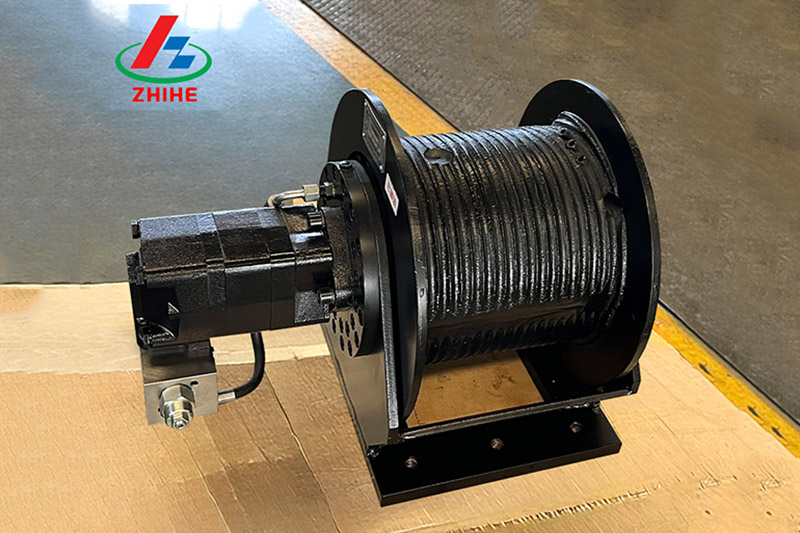
Before we explore “how to choose,” let’s define “what we are choosing.” Unlike traditional worm gear or multi-stage helical gear winches, a planetary reduction hoisting mechanism uses a compact planetary gear system (Sun gear, Planet gears, and Ring gear) to transmit power.
Power flows from the hydraulic motor into the sun gear, driving the planet gears to rotate and revolve, which turns the winch drum. This design offers unparalleled advantages:
The 5 Core Advantages of Planetary Reduction
- Extremely High Torque Density: This is crucial for truck-mounted cranes where space is limited. Planetary gears distribute the load across multiple gears, allowing them to transmit immense torque in a package 30%-50% smaller than traditional gearboxes.
- Superior Transmission Efficiency: Achieving up to 95% efficiency, planetary systems reduce energy loss and heat generation, leading to better fuel economy for your truck.
- Exceptional Stability: The load is shared among several planet gears, significantly reducing stress on individual components and extending service life.
- Precision Control: Planetary systems offer a wide range of precise reduction ratios, enabling exact control over lifting speeds and positioning.
- Highly Integrated Design: Modern winches, like the solutions from ZHIHE, integrate the hydraulic motor, fail-safe multi-disc brake, and counterbalance valve into a single unit, simplifying installation and maintenance.

The 8 Key Technical Standards for Selecting a Crane Winch
Choosing the wrong hoist is like putting a tractor engine in a sports car. Here are the 8 technical parameters you must scrutinize.
1. Rated Load Capacity (Single Line Pull)
This is the primary parameter. However, “Rated Load” usually refers to the pull on the first layer of the drum.
- The Reality: As the wire rope winds onto the drum, the effective diameter increases, and the line pull decreases. The pull on the 5th layer might only be 70% of the 1st layer.
- Pro Tip: Select your winch based on the “outermost layer load” requirement, or ensure a safety factor of at least 1.25x on the first layer.
2. Hoisting Speed (Single Line Speed)
Speed determines efficiency. You must balance the hydraulic motor’s displacement with your system’s flow rate.
- Small Displacement: Faster line speed, lower torque.
- Large Displacement: High torque, slower speed.
- Selection Advice: Ensure the winch provides a fast no-load speed for efficiency and a stable full-load speed for safety.
3. Reduction Ratio (Gear Ratio)
The reduction ratio defines the trade-off between speed and power.
- High Ratio (e.g., 40:1): Powerful torque output, ideal for heavy lifting.
- Low Ratio (e.g., 10:1): Faster speeds, less torque.
- ZHIHE Recommendation: Accurately match the ratio to your specific tonnage class to avoid underpowering your crane.
4. Drum Capacity & Wire Rope Specifications
“Power to lift” and “height to lift” are different.
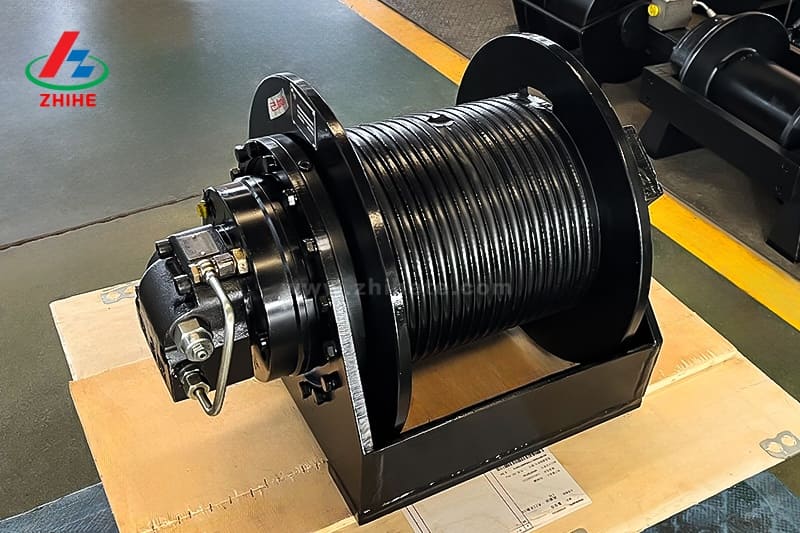
- Drum Capacity: Ensure the drum can hold enough rope for your maximum lifting height.
- Rope Grooves: The drum grooves must perfectly match your wire rope diameter (e.g., 10mm vs 14mm) to prevent rope crushing and premature wear. A rope presser is recommended to ensure even spooling.
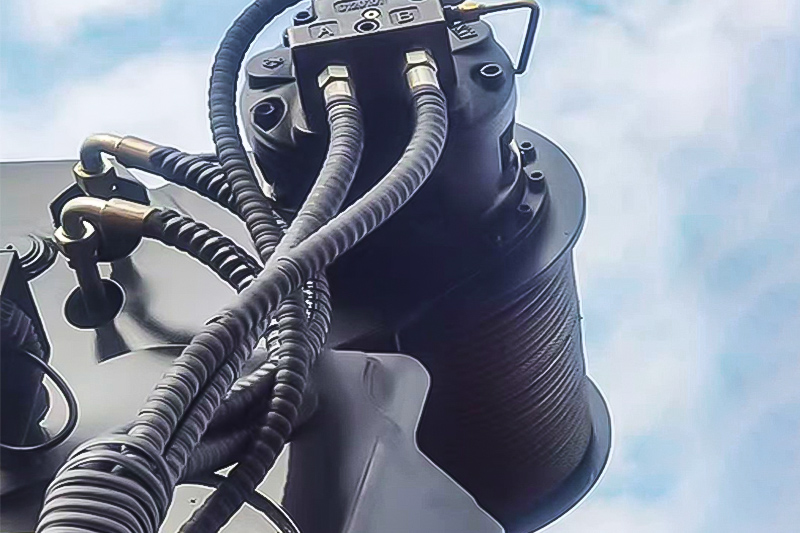
5. Hydraulic System Compatibility
The winch must match your crane’s hydraulic “blood pressure.”
- Working Pressure (Bar/MPa): The winch’s rated pressure must not exceed your system’s relief pressure.
- Flow Rate (L/min): Insufficient flow will cause the winch to underperform.
- Counterbalance Valve: A high-quality winch must include this valve to prevent the load from “creeping” down and ensuring smooth lowering.
6. Braking System – The Safety Bottom Line
The brake is non-negotiable. Planetary winches use a Fail-Safe Multi-Disc Brake.
- How it Works: It is “Spring-Applied, Hydraulically-Released” (SAHR). If a hydraulic hose bursts, the springs instantly engage the brake to hold the load.
- Safety Margin: The brake’s static holding torque is typically >1.5x the rated load torque.
7. Structural Strength & Durability
Truck cranes operate in harsh outdoor environments.
- Materials: Gears should be made from high-strength alloy steel (like 20CrMnTi) with proper heat treatment (carburizing/quenching).
- Sealing (IP Rating): High-quality oil seals are essential to prevent water and dust from contaminating the gearbox oil.
8. Manufacturer Professionalism
A general gearbox factory differs from a dedicated hoisting mechanism manufacturer. A specialist like ZHIHE understands the unique challenges of truck-mounted cranes, such as dynamic shock loads and frequent start-stop cycles.
Common Pitfalls: Don’t “Save Money” Here
- The Price-Only Fallacy: Cheap winches often cut corners on brake materials or gear heat treatment. The cost of a single safety failure far outweighs any initial savings.
- Selecting at the Limit: Buying a 5-ton winch for a 5-ton load leaves no margin for safety or dynamic shocks. Always leave a buffer.
- Ignoring Maintainability: Choose a design that allows for easy oil changes and brake inspections.
Conclusion: An Investment in Safety and Efficiency
Selecting a hoisting mechanism is a systems engineering decision that impacts efficiency and human safety. The planetary reduction winch is the industry’s gold standard for its compactness and reliability.
Before making your final decision, compare your requirements—load, speed, hydraulic specs—against the 8 standards in this guide.
Ready to upgrade your truck-mounted crane? Contact the engineering team at ZHIHE Intelligent Equipment today. We provide professional consultation and custom planetary winch solutions tailored to your specific drilling and lifting needs.